


Orpheus the Cicada Necklace
Every summer there is a moment, usually in the fullness of July when the heat has settled into everything and the trees have gone perfectly still, when a sound starts up that stops you completely. It begins in one tree and then another takes it up and then another until the whole forest is vibrating with it, this ancient pulsing song that seems to come from everywhere and nowhere at once. You did not hear it start. You cannot find exactly where it is coming from. You only know that the world was quiet and now it is not, and something that has been underground for a very, very long time has finally found its way back into the light.
The Cicada
Cicadas have been singing on this earth for roughly 40 million years, and fossil evidence suggests their ancestors were making sound for up to 200 million years before that. They were here before most of what we recognize as the modern world existed, and they have not changed their approach since. They know something we do not about patience.
Periodical cicadas spend about 99 percent of their lives entirely underground, feeding quietly on tree root sap in the dark, waiting. They are not sleeping. They are actively living their lives beneath our feet, growing through the slow passage of either 13 or 17 years while we go about our business above them completely unaware. Then, when the soil temperature reaches exactly 64 degrees Fahrenheit at a depth of 12 to 18 inches, something shifts. Because that soil temperature is reached all at once across a whole region, they emerge together in a synchronous mass, millions at a time, climbing up out of the earth, shedding their nymphal shells, and pumping fluid into their wings. The whole transformation takes about 30 minutes.
Only the males sing. They produce sound using a pair of ribbed membranes called tymbals on the sides of their abdomen, contracting the muscles attached to them up to 50 times per second. The abdomen itself is largely hollow, which acts as an amplifier, and the resulting song can reach 90 decibels, roughly the volume of a lawnmower, aimed entirely at the females listening below. All of those years underground. All of that patience. And then a few glorious weeks of light and song before the cycle begins again.
The Piece
His name is Orpheus, after the legendary musician of ancient Greek mythology whose voice was so extraordinary that rivers stopped flowing to listen, trees uprooted themselves to move closer, and even the stones of the earth turned toward the sound. It felt like the only right name for an insect whose song has been stopping the world in its tracks for 200 million years.
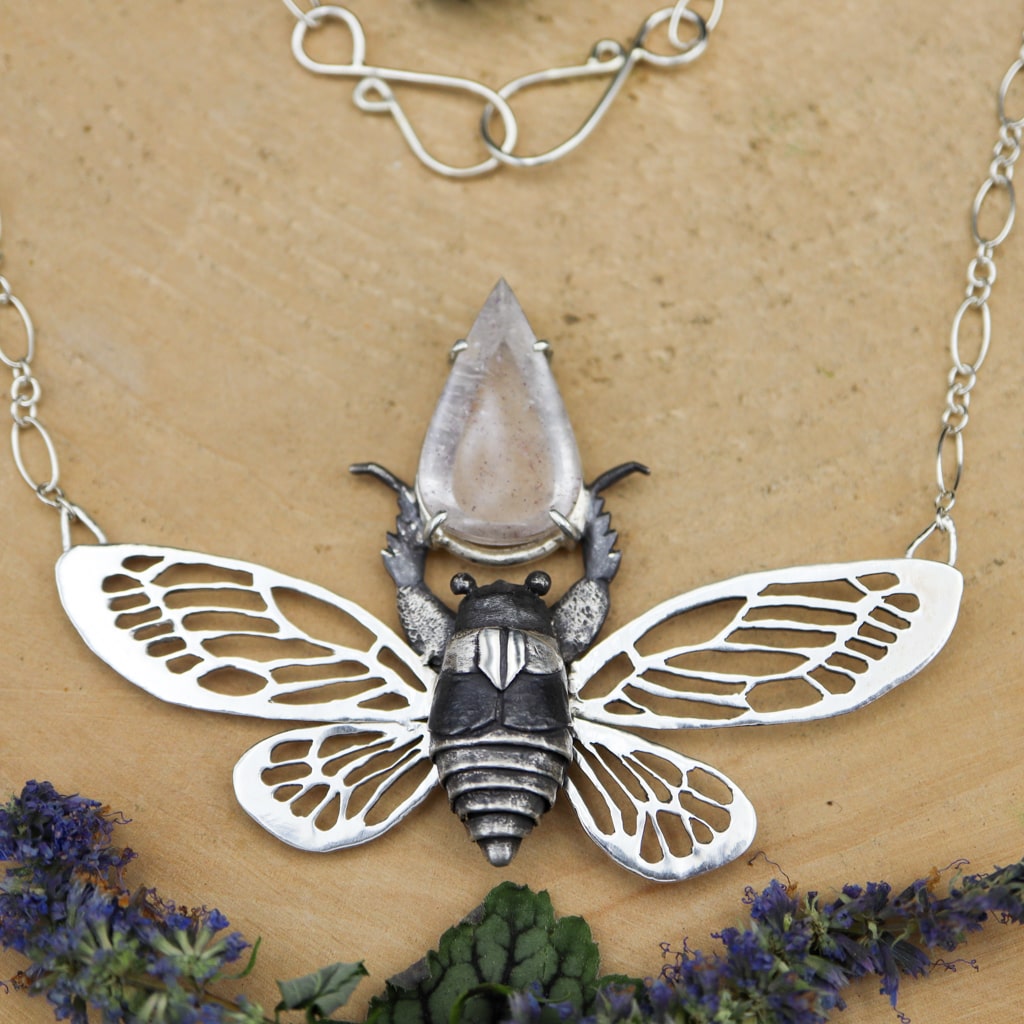
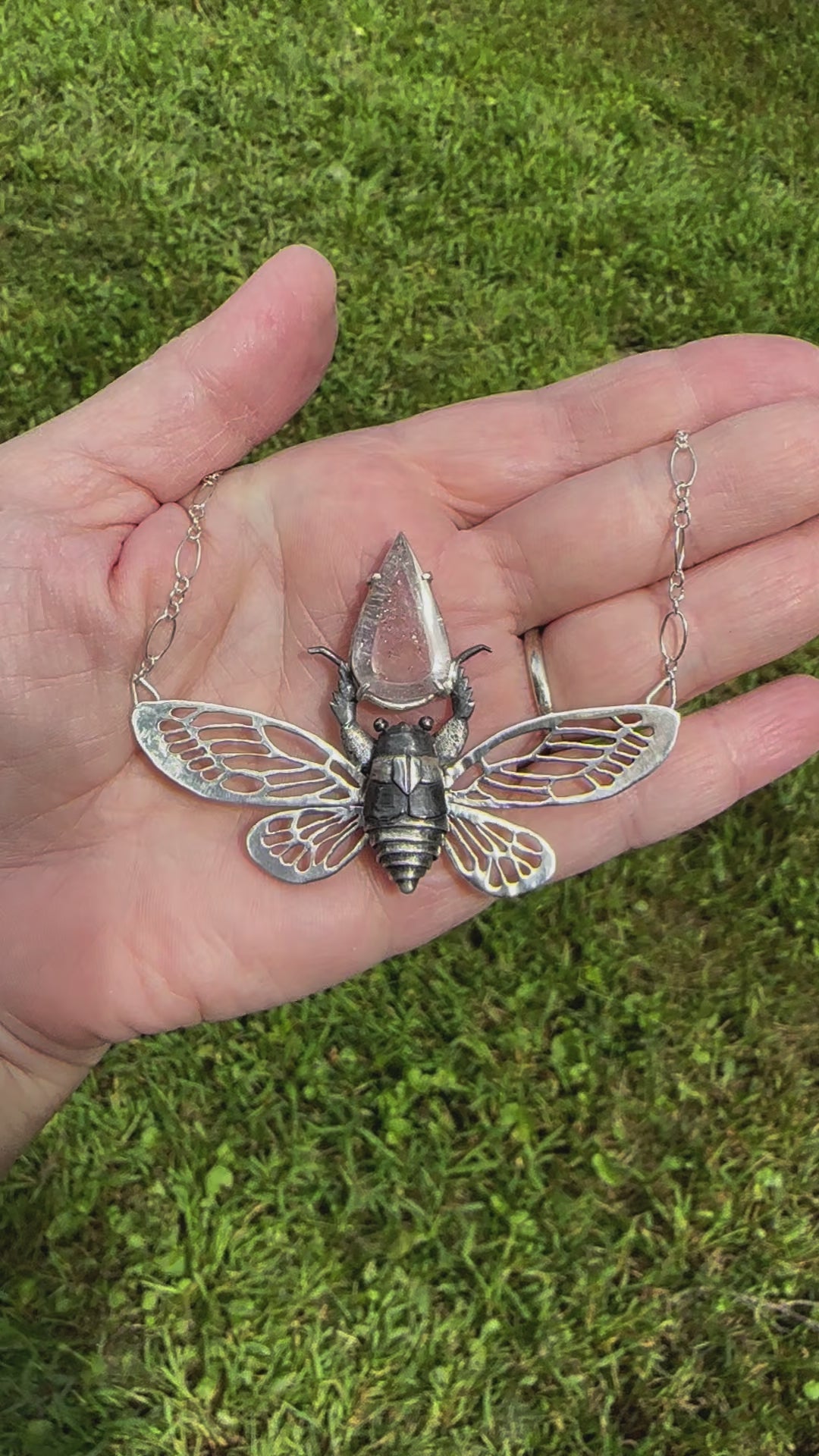
Orpheus spreads his four wings wide across your chest, each one pierced by hand in the precise venation pattern of a real cicada, every individual cell of the wing carefully sawn out of solid sterling silver so the light passes through them the way summer light passes through real cicada wings. His body is deeply oxidized and carved with small decorative plates that mimic exactly what a cicada looks like in the wild, the thorax and abdomen segmented and textured with the kind of detail that rewards a close look. He is just over three inches wide from wingtip to wingtip.
His front legs reach upward to hold his stone aloft, and the stone is extraordinary. It is a covellite in quartz, a genuinely rare combination that first appeared on the collector market only in 2005 and has been difficult to find ever since. The covellite inclusions are suspended inside the clear quartz like frozen sparks, looking almost unremarkable when you first glance at them. And then the light shifts, and the whole stone flashes a vivid, saturated purple that seems to come from somewhere deep inside it. It is the kind of stone that makes people stop and turn it in their hands trying to catch that flash again. Orpheus holds it up like the lyre his namesake always carried, as if the stone itself is the source of the song.
The necklace is 20 inches long on a sterling silver loop chain with a twisted wire bail, and can be adjusted shorter if you prefer.
The Craftsmanship
- Pendant: just over 3 inches wide from wingtip to wingtip
- Stone: covellite in quartz teardrop, purple flash, claw set
- Material: sterling silver throughout, oxidized
- Chain: 20 inch sterling silver loop chain, adjustable
- Edition: one of a kind
One of a Kind
There is only one Orpheus. These pierced wings, this particular stone with its hidden purple fire, this exact song frozen in silver: they exist once. When he finds his person he will never be made again exactly like this.
A Note from Tamara
I find cicadas genuinely delightful, which I realize is not everyone's first reaction to an insect that emerges by the millions and makes an enormous amount of noise. But once you know their story, once you understand what 17 years underground feels like as a concept and then imagine that first moment of breaking through into the light and the warmth and the summer air, it is hard not to root for them completely. I named him Orpheus because both of them understand something the rest of us are still learning, that a voice powerful enough and patient enough can move the whole world. I chose the covellite in quartz because it looks quiet until the light finds it and then it is suddenly, brilliantly, unmistakably itself. That felt right for a cicada. I hope whoever wears Orpheus feels a little of that same energy, something that has been quietly building for a long time and is finally, joyfully, ready to be heard.
Shipping
Your Orpheus is finished, packaged safely, and will be on his way to you within 3 to 5 business days.

Choose options